Why I love oil pastels so much: Experiences & tips
I've been painting with oil pastels for quite some time now and have really grown to love them. At first, they seemed rather coarse and a bit unwieldy to me... today, I appreciate their unique qualities. Because once you know how to use them, they are incredibly fun and open up many exciting possibilities.
The surfaces that work well for me
What I particularly like about oil pastels is how surprisingly flexible you are with the painting surfaces. Whether paper or panel ... both work very well for me.
Paper
A real advantage of oil pastels, I find, is that you don't necessarily need expensive special papers. For soft pastels, I would definitely prefer high-quality pastel papers like Pastelmat or Canson Mi-Teintes Touch, because they really make a big difference there. I think those are great too... but they're not exactly cheap. With oil pastels, I can also paint on mixed-media paper; it doesn't even necessarily need to be primed.
Painting Panels
So far, I've had good experiences with HDF panels and gessoed painting panels. I prime both with clear gesso. This gives the surface more grip, allowing me to layer better. It feels finely sandy afterward...

Why I like to start with an underpainting
I really like to use an underpainting beneath the oil pastels. This way, I don't start on a completely white surface, but can already roughly lay down light, shadow, and color areas. This makes the start looser and more vibrant.

Another advantage for me is that the white of the ground doesn't show through as quickly later on. Especially since it can be quite time-consuming to completely fill large areas with oil pastels, an underpainting helps me enormously. This makes the painting appear more cohesive and harmonious right from the start.
For this underpainting, you can work well with other painting media, such as acrylics, oil paints, or gouache. I personally particularly like to use gouache for this, because it dries quickly and is easy for me to use.
I have also experimented with linseed oil. With it, oil pastels can be worked almost like paint. Especially for a first loose layer of color, this can be very exciting. You just have to be careful not to use too much linseed oil... otherwise, it quickly becomes too greasy and takes a very long time to dry, almost like oil paint. Sennelier recommends using turpentine for thinning, but this can produce harmful fumes.
It becomes more difficult if you want to apply other painting media over it later (as oil pastel is very oily, creamy, and nothing adheres to it). That's why I tend to use oil pastels higher up in the painting's construction or at the very end.
What I love about layering
For me, this is one of the biggest advantages. With oil pastels, I can work layer by layer and slowly build up the painting. Colors can be wonderfully layered, intensified, and further developed.

I usually start darker and only add the light accents later. Often, it's these last light areas that really make a painting shine for me.

How I blend oil pastels
With oil pastels, you can create soft transitions, but also vibrant surfaces. Their creamy consistency allows colors to blend beautifully... sometimes very gently, sometimes with visible strokes.
I prefer to blend with my fingers. The warmth makes the colors even smoother, and I get particularly nice transitions. Especially when working this way, I think it's important to use non-toxic oil pastels and wash your hands afterward.
However, applying larger areas very evenly is not as easy compared to soft pastels, which is more of a disadvantage.

Why I love using the palette knife
I also love this about oil pastels. You can remove paint with the palette knife and apply it thickly. This creates exciting, almost three-dimensional areas that sometimes resemble oil paint.

I really enjoy this interplay: soft and blended in some places, thickly applied and clearly visible in others. It's precisely this variety that makes the material so vibrant for me.

When the palette knife becomes an eraser
The palette knife works not only for applying, but also for removing. Scraping creates beautiful textures, for example, for grass or fine lines. At the same time, you can also correct and rework areas this way.
You could almost say: for oil pastels, the palette knife is something like my eraser.
Why I like to present oil pastel paintings openly
Even when presenting, oil pastels have a special charm for me. Unlike soft pastels, they don't necessarily have to disappear behind glass and a mat.

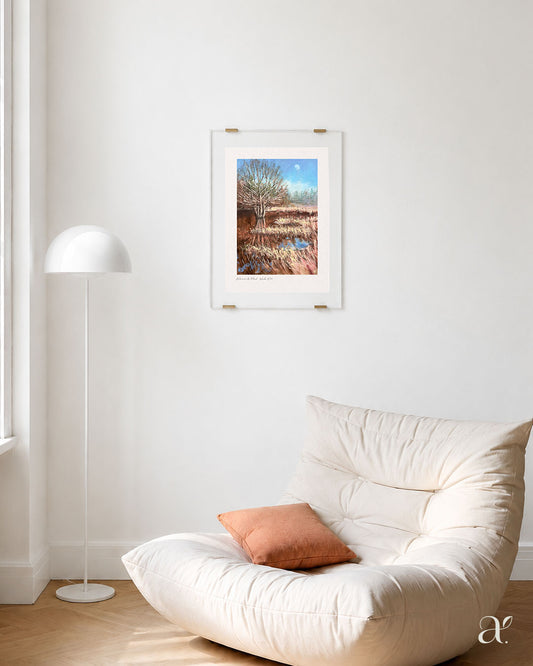
I like to fix my paintings on HDF panels with a special fixative spray for oil pastels and then frame them in a float frame. This makes them look almost like small oil paintings.

Especially when the surface is allowed to remain visible, an important part of the material truly comes into its own for me.
Soft pastel or oil pastel?
Actually, oil pastels and soft pastels can only be compared to a limited extent, as they are simply different materials with different effects.
However, in comparison, a few typical strengths of oil pastel become particularly clear to me: for example, it is not dusty, richer in application, and somewhat more versatile in layering, blending, and texturing.

I also find oil pastels to be less complicated regarding the surface. For soft pastels, the tooth of the paper is much more important. With oil pastels, I don't necessarily need that. I can also work very well on mixed-media paper or primed painting panels.
Another advantage for me is the reduced sensitivity of the finished painting. Soft pastels remain very delicate even after fixing. Oil pastels are also not completely insensitive, but for me, they are more robust in everyday use and thus easier to store.
Of course, the material also has its drawbacks. Oil pastels can initially seem coarse and a bit unwieldy, smudge easily, and require some practice. Those who want to work very finely and precisely often need patience with them. And filling larger areas, I find, is significantly more labor-intensive with oil pastels than with soft pastels. Soft pastels, on the other hand, often appear airier, lighter, and in some places finer.
Oil pastels are bolder, more direct, and sometimes a bit more stubborn... but for me, that's exactly what makes them so appealing!

These are a few more paintings I've done with oil pastels. Portraits also turn out beautifully with them!
Conclusion
Oil pastels have truly won me over over time. What initially seemed unfamiliar is now exactly what I appreciate about them: their versatility, their luminosity, and the many possibilities to play with surface, structure, and contrasts.
If you get a little bit into their peculiarities, they can be incredibly fun... and that's exactly why I enjoy painting with them so much today.
Materials at a Glance
Here you will find a collection of the materials I like to use for my oil pastel paintings. If you order via these "affiliate links" from Amazon, I receive a small commission. The price for you remains the same, of course. You effortlessly support my work and this blog. Thank you very much for that!
- Sennelier Oil Pastels: The Sennelier set is not cheap. However, the pastels are very creamy, rich in pigments, and have excellent opacity and lightfastness. This comes at a price.
- Simple, harder oil pastels: I like to combine the Sennelier set with this simple Artecho product. They are not quite as creamy and much firmer. But I find this precisely good if you want more texture in the painting.
- Paper: The advantage of oil pastels is that you don't need expensive special pastel paper. I like to use the yellowish and gray-toned CANSON Graduate Mixed Media Paper. I don't like to paint on completely white paper. If you want, you can prime it with clear gesso.
- Clear Gesso: I use this primer on all surfaces (whether paper or HDF boards). It is the ideal primer not only for oil pastels, but also for pastels, graphite, charcoal, acrylics, and oil paintings... It is transparent and leaves the surface beautifully "sandy" after drying.
- Fixative Spray: I like to use this fixative spray from Sennelier, which is specially developed for oil pastels. I have had good experiences with it; the colors barely change, and it gives a beautiful satin matte finish.
- Linseed Oil: Linseed oil can be used to liquefy oil pastels, allowing them to be painted with a brush (great for underpaintings). I use linseed oil that is actually intended for water-mixable oil paints. It is non-toxic, but it is also suitable for regular oil paints.